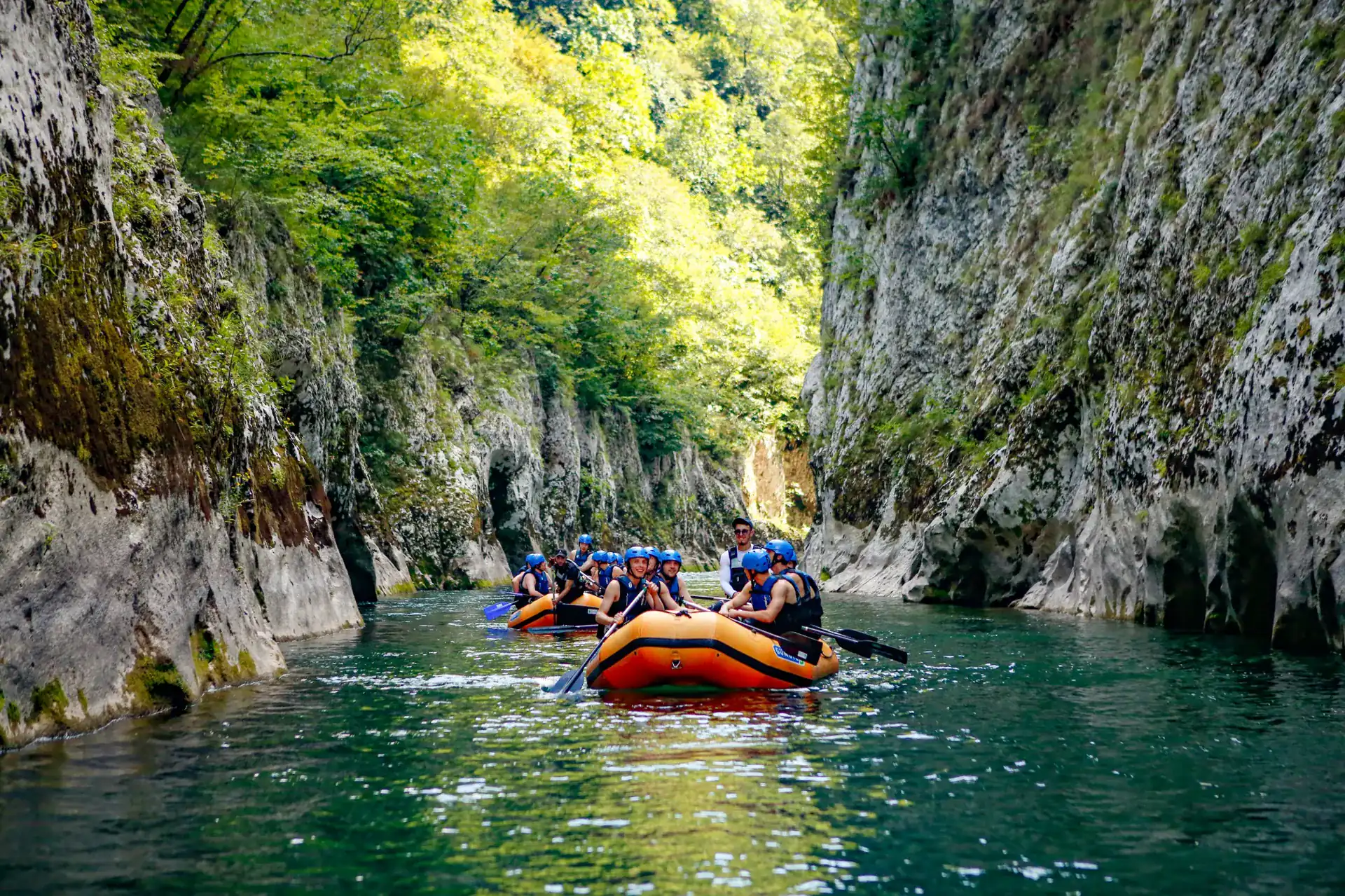
How rafting on the Neretva River began—a battle for the river that continues to this day
After the war events in Bosnia and Herzegovina, life priorities returned to topics that are not narrowly tied to the mere survival of humans as individuals and society.
The need was revived to think not only about preserving bare lives but also about living space and what makes it more complete, sustainable, meaningful, and civilized.
In 1996, when the initiative was launched—or better said, revived—for the construction of as many as four large hydroelectric power plants on the upper course of the Neretva River: HE Konjic, HE Glavatičevo, HE Bjelimići, and HE Ulog, the question of the impact of these eventual constructions on the living space was also raised.
The planned HE Konjic represented a particular enormous threat, as its construction would have flooded the entire Gornja Neretva canyon from Konjic to Glavatičevo, one of the deepest and, with its flora and fauna, especially endemic species, perhaps the most valuable canyons in Europe.
The Beginning of the Fight for Gornja Neretva
Citizens of Konjic, enthusiasts and nature lovers, alongside this initiative for HE construction, launched a strong campaign to protect the Neretva River. Through numerous activities, public initiatives, and gatherings, the key goal of opposition was highlighted, which, in addition to the mentioned reasons, also emphasized the possibility that the river could be "used" in a sustainable way, without destroying nature.
Kayak Club and First Rafting on Neretva
As the first concrete response, a kayak club was founded, which gathered a large number of Konjic residents. Parallel to the club's work, non-commercial rafting on the upper course of the Neretva River began to be organized, primarily with the goal of showing the domestic and foreign public the beauty, purity, and tourism potential of the river and the nature that would be destroyed by HE construction.
Rafting in that period was not a business, but a means of fighting to preserve the river.
Rafting Becomes Commercial
In 1998, after enormous visitor interest, rafting on the Neretva grew into a commercial tourism activity, which became one of the valid proofs that "Gornja Neretva" could have economic value as a living, preserved river, and not as a water accumulation for energy production.
The First Great Victory
Years of struggle brought a significant result when, due to pressure from citizens and nature protection associations, the HE Konjic hydroelectric power plant was completely removed from all regulatory and spatial plans. The Gornja Neretva canyon was saved, and the path was opened for the development of rafting and sustainable tourism.
The Fight That Continues
The fight against the construction of other planned hydroelectric power plants on the Neretva did not stop. It is still active. The development of tourism, rafting, and other forms of tourist offerings related to the Neretva River in this part of its course is a stable foundation to prevent planned initiatives and preserve this space in its natural environment.
Thus, rafting on the Neretva is not just an experience, an adventure in nature, and a symbol of love for the river, but also a symbol of resistance and proof that the river can, even in modern ways of living, be a "source of life" without being sacrificed.
Raft Bosnia proudly continues this story, offering rafting tours that respect the river and its values.